

Your cart is empty
Start shopping to add items to your cart
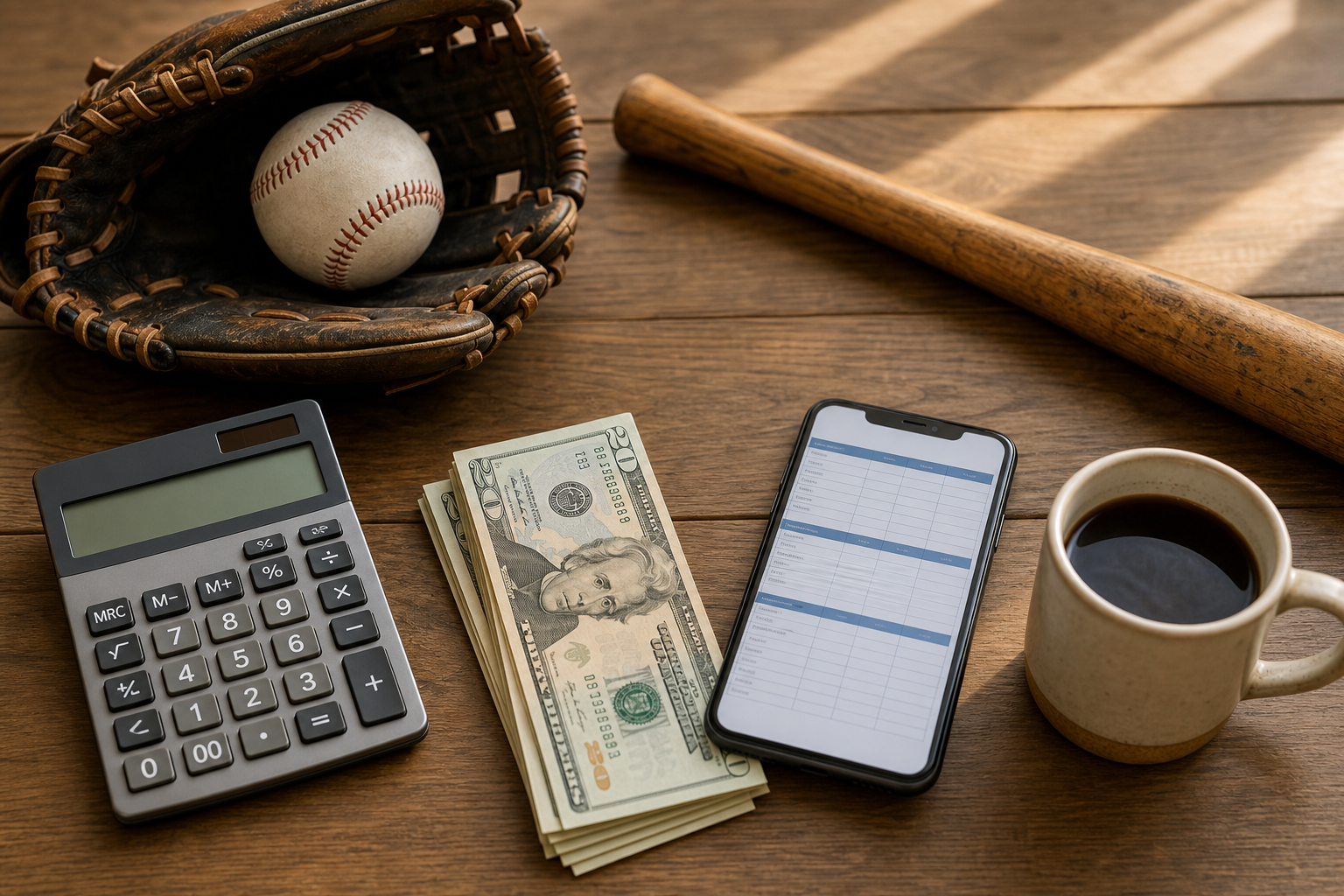
From team fees to tournament travel to equipment — the real cost of travel baseball broken down so you can budget like a pro
Turn2 Team
Turn2 Threads Team
Nobody tells you how much travel baseball actually costs before you sign up. The coach says "team fees are $1,500." What they don't mention is the $400 bat, the $50 weekend gate fees, the hotel rooms, the gas, the meals on the road, the private lessons, the indoor facility rentals in the winter, and the "oh, we need matching warmup shirts" that somehow cost $80.
I've been through it. This is the budget breakdown I wish someone had handed me before that first season. Real numbers, honest ranges, and exactly where you can save money.
The Bottom Line Up Front
A full travel baseball season costs $3,000 to $15,000+ per player. The average family spends around $5,000-$8,000. The biggest variable is how far you travel and how many tournaments you play.
This is the big one you'll pay upfront. Team fees cover:
What affects the price: Professionally coached teams cost more than parent-coached teams. Teams that rent indoor facilities in winter cost more. Elite showcase programs with name-brand coaches cost the most.
Money-saving tip: Ask what's included before you pay. Some teams quote a low fee but charge extra for everything — tournaments, uniforms, warmups, end-of-year banquet. Get it in writing.
Some teams include tournament fees in the team fee. Others bill them separately as "gate fees" or "tournament fees" — typically $50 to $150 per family per weekend.
A typical season includes 8-15 tournaments. At $100 per weekend, that's $800-$1,500 per season just to get in the gate.
What you're paying for: Field rentals, umpires, tournament staff, insurance, trophies, and the tournament director's profit margin.
Money-saving tip: Some tournaments offer "early bird" discounts if you register 30+ days in advance. Ask your coach to plan the tournament schedule early and register early.
This is the biggest variable and the one that surprises most parents. Here's what it actually costs:
Gas: If your tournaments are within 45 minutes of home, you'll spend $200-$400 on gas for the season. If you're driving 2+ hours each way, expect $800-$1,500.
Hotels: Local tournaments (within 1 hour) — $0. Regional tournaments (1-3 hours) — $200-$600 per weekend. National tournaments (fly-in) — $1,000-$3,000 per weekend.
Meals: $30-$60 per person per day on the road. For a family of 4 at a 3-day tournament: $360-$720 per weekend.
Mileage: At the IRS 2026 rate of 72.5 cents per mile, a 200-mile round trip costs $145. A season of 10 tournaments at that distance: $1,450.
Money-saving tip: Carpool with teammates. Share hotel rooms with another family. Pack coolers with food instead of eating out. Choose a team that plays mostly local tournaments.
This is the category where parents overspend the most. Here's what you actually need:
Bat: $100-$500. A good alloy bat for 8U-12U costs $100-$200. A composite bat for 13U+ costs $300-$500. Do not buy a $400 bat for a 9-year-old.
Glove: $50-$200. A quality youth glove costs $60-$100. A high-end adult glove costs $150-$250. Break it in properly and it lasts 3-5 seasons.
Cleats: $30-$100. Molded cleats for youth cost $30-$60. Metal cleats for high school cost $60-$100. Replace every season or two.
Batting gloves: $15-$40 per pair. Your kid will go through 2-3 pairs per season.
Helmet: $30-$60. Buy a NOCSAE-certified helmet. Replace every 3-5 years.
Catcher's gear: $150-$400 if your kid catches. Chest protector, shin guards, helmet, mitt.
Bag: $40-$150. A durable bat bag with backpack straps is worth the investment.
Money-saving tip: Buy used for growing kids. Facebook Marketplace and Play It Again Sports are goldmines for youth equipment. The only things you should never buy used: helmets (safety standards expire) and batting gloves (they're already broken in to someone else's hand).
This is optional but common. Most travel ball families do at least some private instruction:
Hitting lessons: $50-$100 per hour. Once a week for 6 months: $1,200-$2,400.
Pitching lessons: $60-$120 per hour. Once a week for 6 months: $1,440-$2,880.
Catching lessons: $50-$80 per hour. Less common but valuable for dedicated catchers.
Strength & conditioning: $40-$80 per session. Group sessions are cheaper.
Money-saving tip: Group lessons ($25-$40 per player) are almost as effective as private lessons for younger players. Save the 1-on-1 instruction for 13U+ when mechanics get more complex.
If you live in a cold-weather state (or even a state with rainy springs), your team will need indoor practice space. Some teams include this in team fees. Others bill separately.
Indoor facility rental: $100-$200 per hour for a team. Split 12 ways: $8-$17 per player per practice. If you practice 2x/week for 3 winter months: $200-$400 per player.
Money-saving tip: Some indoor facilities offer "team packages" at a discount. Ask your coach to negotiate a bulk rate.
The stuff nobody budgets for but everyone pays:
| Category | Low End | Average | High End |
|---|---|---|---|
| Team Fees | $1,500 | $2,500 | $4,000 |
| Tournament Fees | $500 | $1,000 | $2,000 |
| Travel & Lodging | $1,000 | $2,500 | $6,000 |
| Equipment | $500 | $800 | $1,500 |
| Private Lessons | $0 | $1,500 | $5,000 |
| Indoor Facilities | $0 | $500 | $1,000 |
| Miscellaneous | $200 | $300 | $500 |
| TOTAL | $3,700 | $9,100 | $20,000 |
1. Ask for the full cost upfront. Before you commit to a team, ask the coach for a complete cost breakdown. If they can't or won't provide one, that's a red flag.
2. Set up a dedicated savings account. Put $200-$500 per month into a travel baseball account starting 6 months before the season. By opening day, you'll have $1,200-$3,000 ready to go.
3. Use a tournament tracking spreadsheet. Track every tournament: entry fee, gas, hotel, meals, extras. You'll be shocked how fast it adds up — and you'll know exactly what to budget next season.
4. Plan for the "off-season." Winter training (indoor facilities, lessons) is a real cost that catches parents off guard. Budget for it in October, not January.
5. Talk to other parents. Before you join a team, ask a current parent: "What did you actually spend last season?" They'll give you the real number, not the coach's estimate.
Buy used equipment. Facebook Marketplace, Play It Again Sports, and SidelineSwap are goldmines. A $400 bat from last year's model costs $150 used and performs identically.
Carpool to tournaments. Split gas and parking with another family. It's better for the environment and your wallet.
Share hotel rooms. A 2-bedroom suite split between two families costs half as much per family. Plus the kids get to hang out together.
Pack food. A cooler with sandwiches, fruit, and drinks saves $30-$50 per tournament day. That's $300-$750 per season.
Choose local tournaments. A team that plays mostly within 1 hour of home will cost $3,000-$5,000 less per season than a team that travels regionally.
Ask about scholarships. Many travel organizations offer need-based scholarships or payment plans. You won't know unless you ask.
Check out our Tournament Terms Dictionary to decode every term you'll hear, and our Equipment Guide to make sure you buy the right gear.
Shop Turn2 Threads Gear →Most families spend $5,000-$8,000 per season. The range is $3,000 (local team, minimal travel, used equipment) to $15,000+ (elite showcase program, national travel, private lessons, new equipment every season).
Travel and lodging is the biggest variable. A team that travels 2+ hours to tournaments will cost $3,000-$6,000 more per season than a team that plays locally. Private lessons are the second biggest expense for families who use them.
It depends on your goals. If your kid loves baseball and wants to play at a higher level, travel ball provides better coaching, better competition, and more development opportunities than rec ball. But it's a significant financial commitment. Talk to other parents, watch a practice, and make sure the program is a good fit before you commit.
Some organizations offer need-based scholarships or reduced fees. Ask the coach or organization director. Many teams also offer fundraising opportunities — selling raffle tickets, running a concession stand, or participating in team-sponsored events.
Buy used. Facebook Marketplace, Play It Again Sports, and SidelineSwap have excellent used equipment at 50-70% off retail. The only things you should buy new: helmets (safety standards expire) and batting gloves (they mold to the hand).
Whether you're in the dugout or the stands, Turn2 Threads has the gear to match your baseball lifestyle. Check out our latest drops.
Join our newsletter for gear guides, tournament tips, and exclusive drops from Turn2 Threads.
The official Cooperstown Dreams Park packing list tells you how many baseball pants to bring. It does not tell you about the group showers, the walking, or the fact that your kid will trade away his best pin on day one. Here's the packing list written by families who have already been.
Confused when your kid talks about hitting tanks, throwing cheese, or rocking lettuce? This baseball slang dictionary helps travel ball parents understand the language of youth baseball in 2026.
From dingers to tanks to nukes, here's what today's young hitters are saying and why exit velocity is everything.